An official website of the United States government


 ) or https:// means you've safely connected to the .mil website. Share sensitive information only on official, secure websites.


Ebola first appeared in 1976 during two outbreaks in Central Africa. The first recognized outbreak occurred in Yambuku, Zaire (now the Democratic Republic of the Congo). A total of 318 people became sick, and 280 died.
In Yambuku, the virus spread mainly through reused needles and syringes at a local mission hospital. It also spread through close contact with infected people. The first patient was treated for suspected malaria. The most cases occurred near Yambuku village. Only 38 people survived.
After the first outbreaks in 1976, the next major outbreak happened in West Africa from 2014 to 2016. It became the largest Ebola outbreak ever recorded. By late 2014, hospitals in Liberia, Sierra Leone and Guinea filled with sick patients. In response, the government of Liberia asked the U.S. Department of Defense for help to stop the outbreak.
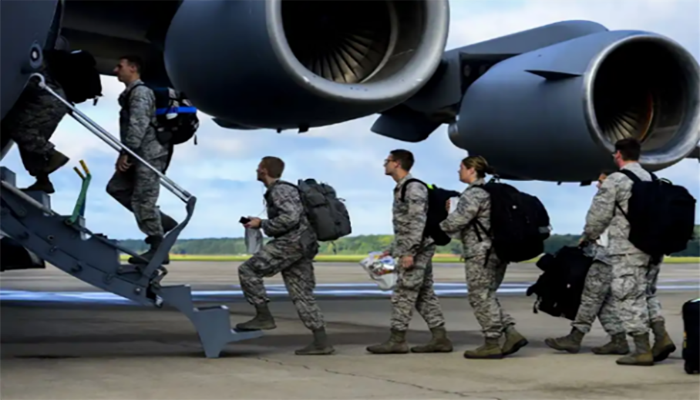
Airmen assigned to the 633rd Medical Group board a C-17 Globemaster at Langley Air Force Base, Va., Sept. 26, 2014. The 633rd Medical Group packaged and delivered a modular medical treatment center, as part of a governmentwide effort to support humanitarian relief operations in Ebola-stricken African nations. (U.S. Air Force photo by Senior Airman Kayla Newnan)
The U.S. military launched Operation United Assistance. Service members, scientists, and public health experts worked together to slow the spread of the virus. Within a few months, the Department of Defense built six medical labs in Liberia. Laboratory technicians from the U.S. Army Medical Research Institute of Infectious Diseases and the Naval Medical Research Center processed more than 4,500 Ebola tests in laboratories over four months.
Military teams also trained more than 1,500 local healthcare workers. These efforts made a difference, as new Ebola cases in Liberia dropped from hundreds each week in September 2014 to fewer than two a week by March 2015. These actions gave doctors what they needed to find and treat patients sooner, helping to stop the spread of the virus.
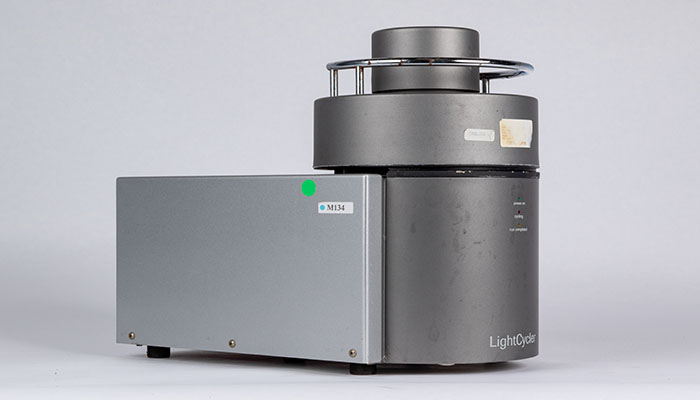
Nucleic Acid Processor, Light Cycler Polymerase Chain Reaction (PCR) machine. Silver-tone metal tabletop PCR machine is used to replicate viral RNA in blood samples for verification of Ebola diagnosis. Used by USAMRIID personnel at Liberian Institute of Biomedical Research to verify the symptoms-based diagnosis of local doctors for quarantine and proper care of Ebola patients in the 2014-2016 outbreak in West Africa. (National Museum of Health and Medicine Photo by Kevin Sommer-Giron)
A key tool in this mission was the Roche LightCycler 2.0, a small polymerase chain reaction machine used by USAMRIID. The LightCycler 2.0 could detect traces of Ebola's genetic material in blood within 30 minutes. It also cut diagnosis time from up to a week to about four hours. Faster testing helped doctors confirm infections and isolate patients for treatment. The machine used heat and cooling cycles to copy the virus's RNA, if it were present. A glowing signal confirmed presence of Ebola nucleic acid, and results were quickly shared with treatment centers.
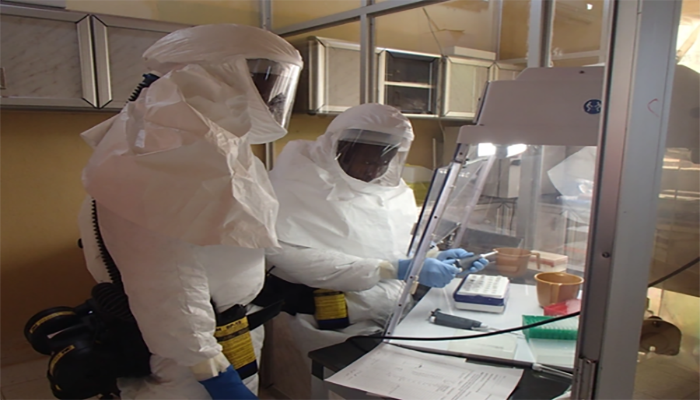
Technicians set up polymerase chain reaction, or PCR, assay for Ebola in a containment laboratory on Oct. 26, 2014. Assay components are assembled in the PCR hood to prevent contamination that could interfere with test results. (U.S. Army photo by Dr. Randal J. Schoepp)
Due to the danger of handling these samples, lab technicians wore full protective suits and cleaned their gear and tools with strong bleach after each batch of tests. They worked long hours and used careful methods to avoid mistakes while processing samples from across the country.
Today, the Roche LightCycler 2.0 in the National Museum of Health and Medicine's collection is one of several artifacts that capture that moment in time when U.S. military medical teams used science to save lives during the 2014-2016 Ebola outbreak. Their work in mobile labs made it possible to test patients quickly, confirm infections and support doctors on the front lines of care. This technology serves as a reminder of how military medicine helped protect communities and control one of the most serious disease outbreaks of the century.
Resources
Centers for Disease Control and Prevention. "Ebola (Ebola Virus Disease)." Updated 2024. https://www.cdc.gov/vhf/ebola/
National Museum of Health and Medicine. Operation United Assistance object records and curatorial notes, 2017.
Roche Diagnostics. "LightCycler Instrument History and Applications." Journal of Molecular Diagnostics, vol. 11, no. 3, 2009, pp. 203-212. https://pmc.ncbi.nlm.nih.gov/articles/PMC2665858/
U.S. Army Medical Research Institute of Infectious Diseases. "USAMRIID Supports Ebola Virus Disease Outbreak Response in West Africa." U.S. Army, 2014. https://www.army.mil/article/136531/
Wong, Gary, et al. "Ebola Virus Disease in Nonhuman Primates." Frontiers in Microbiology, vol. 7, 2016, article 120. https://pmc.ncbi.nlm.nih.gov/articles/PMC5010747/
U.S. Department of Defense. (2014). Operation United Assistance Helps in Liberian Ebola Fight. Retrieved from https://www.defense.gov/News/News-Stories/Article/603343/operation-united-assistance-helps-in-liberian-ebola-fight/
DVIDS. (2015). U.S. Added Speed, Scale to West Africa Ebola Fight. Retrieved from https://www.dvidshub.net/news/504434/us-added-speed-scale-west-africa-ebola-fight
Joint Chiefs of Staff. (2015). Operation United Assistance: The DoD Response to the Ebola Epidemic in West Africa. Retrieved from https://www.jcs.mil/Portals/36/Documents/Doctrine/ebola/OUA_study_aug2015.pdf
CDC. (2024, May 6). Ebola Outbreak History. CDC. https://www.cdc.gov/ebola/outbreaks/index.html